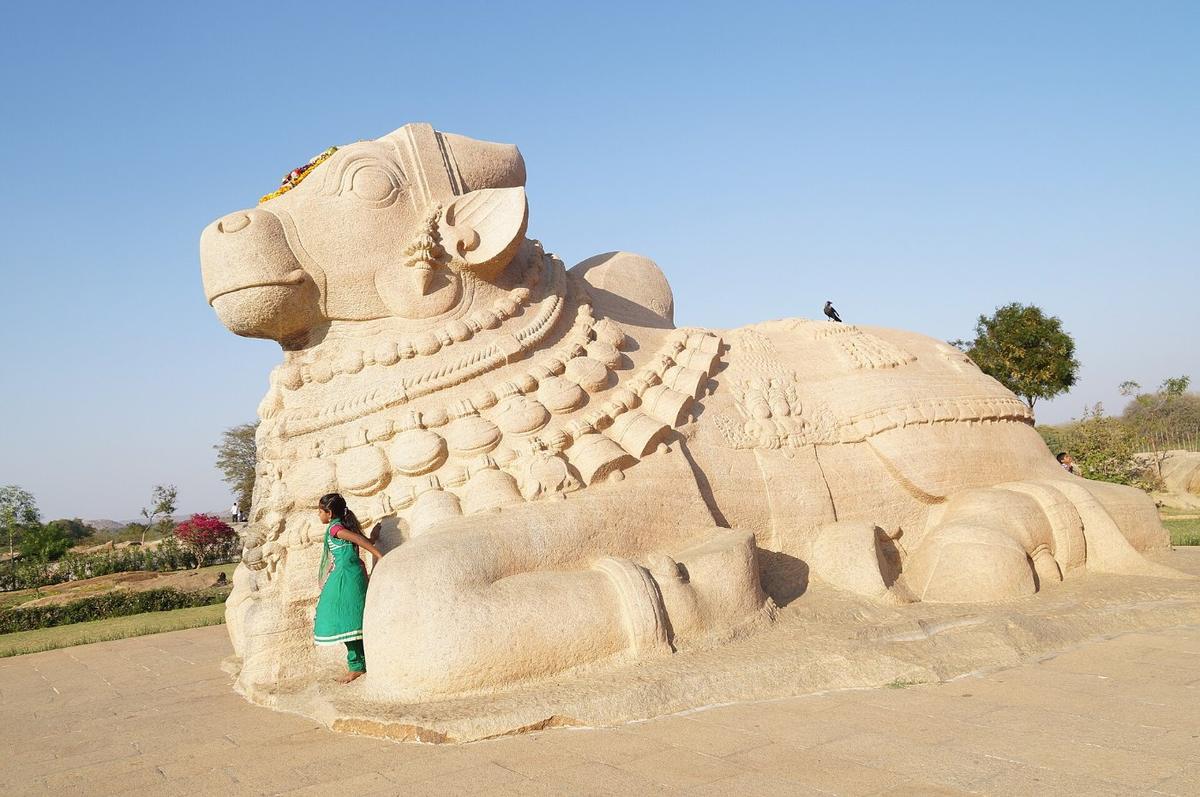
Photo: Lepakshi Nandi, Rahmanuddin, CC BY-SA 4.0

APPSC Group-I Mains 2020 · Paper II
2020 Paper II · Q6(b): model answer
History, Culture & Geography of India and Andhra Pradesh · Ancient and Medieval Andhra. Held in December 2020 (Notification 27/2018).
Write a note on art and architecture under the Pallavas.
Syllabus: Ancient and Medieval Andhra · Early Andhra kingdoms (Satavahanas to Vishnukundins)
Dravida styleRock-cut mandapasMonolithic rathasStructural temples
The Pallavas (c. 3rd–9th century CE) ruled from Kanchipuram; their earliest Prakrit charters, such as the Mayidavolu plates of Shivaskandavarman found in Guntur district, show their early hold over the Krishna region of Andhra. Their greatest legacy is art: they carried South Indian architecture from rock-cut caves to structural stone temples and laid the foundation of the Dravida style perfected by the Cholas.
1. Stages of evolution
- Mahendra style: Mahendravarman I began rock-cut cave temples (mandapas) with pillared halls; the Mandagapattu inscription calls his shrine a temple built without brick, timber, metal or mortar.
- Mamalla style: Narasimhavarman I Mamalla created the monolithic rathas at Mahabalipuram, each carved from a single rock to imitate a different building form, and cave mandapas such as the Mahishasuramardini and Varaha.
- Rajasimha style: Narasimhavarman II built structural stone temples such as the Shore Temple at Mahabalipuram and the Kailasanatha temple at Kanchipuram, with pyramidal vimanas.
- Later Pallava style: Nandivarman II and his successors built temples such as Vaikuntha Perumal at Kanchipuram, whose sculptured panels narrate Pallava history.
| Style | Ruler | Main examples |
|---|---|---|
| Mahendra (rock-cut caves) | Mahendravarman I (c. 600–630) | Mandagapattu and other cave mandapas |
| Mamalla (monoliths and reliefs) | Narasimhavarman I (c. 630–668) | Pancha Pandava rathas; Descent of the Ganga |
| Rajasimha (structural temples) | Narasimhavarman II (c. 695–722) | Shore Temple; Kailasanatha, Kanchipuram |
| Later Pallava | Nandivarman II and successors | Vaikuntha Perumal, Kanchipuram |
2. Sculpture and painting
- Open-air relief: the great relief at Mahabalipuram, the "Descent of the Ganga" or "Arjuna's Penance", shows gods, sages, elephants and even a mock-ascetic cat with lively realism.
- Narrative panels: the Mahishasuramardini panel shows the goddess fighting the buffalo demon, and Somaskanda panels (Shiva with Uma and Skanda) adorn the sanctum walls of Rajasimha's temples.
- Painting and patronage: traces of murals survive in the Kailasanatha temple; Mahendravarman I bore the title Chitrakarapuli and wrote the Sanskrit farce Mattavilasa Prahasana.
3. Andhra link
- Early base: the early Pallavas issued charters in the Krishna–Guntur region before Kanchipuram became their centre.
- Influence: the rock-cut cave temples at Bhairavakonda (Nellore district) show Pallava influence on Andhra's rock architecture.
4. Legacy
- Prototype for the Cholas: the tiered pyramidal vimana led to great Chola temples such as the Brihadeeswara at Thanjavur.
- Wider influence: the Kailasanatha temple influenced the Virupaksha temple at Pattadakal, built under the Chalukyas of Badami, and the Pallava Grantha script spread to Southeast Asia.
- World heritage: the Group of Monuments at Mahabalipuram is a UNESCO World Heritage Site (1984).
The Pallavas thus carried Indian temple architecture from rock-cut caves to structural stone temples, combining engineering skill with naturalistic sculpture and laying the foundation of the Dravida tradition of South India.
The other choice in Q6
Answer either one in the exam.
- Q6(a)Discuss salient features of the Agrarian system under the Satavahanas.
10 marks · Ancient and Medieval Andhra · Early Andhra kingdoms (Satavahanas to Vishnukundins)
Every model answer on these pages is free to read. The Tool Kit adds four PDF books for Mains Papers I–IV: every previous question sorted by syllabus, with practice questions. It is in the ₹149 All-in-One Pass, with every previous paper of every exam on the site, practice quizzes, timed tests, mock test series and study books.
₹149 · valid for 12 months from the day you pay, on every exam · pay by UPI, card or net banking