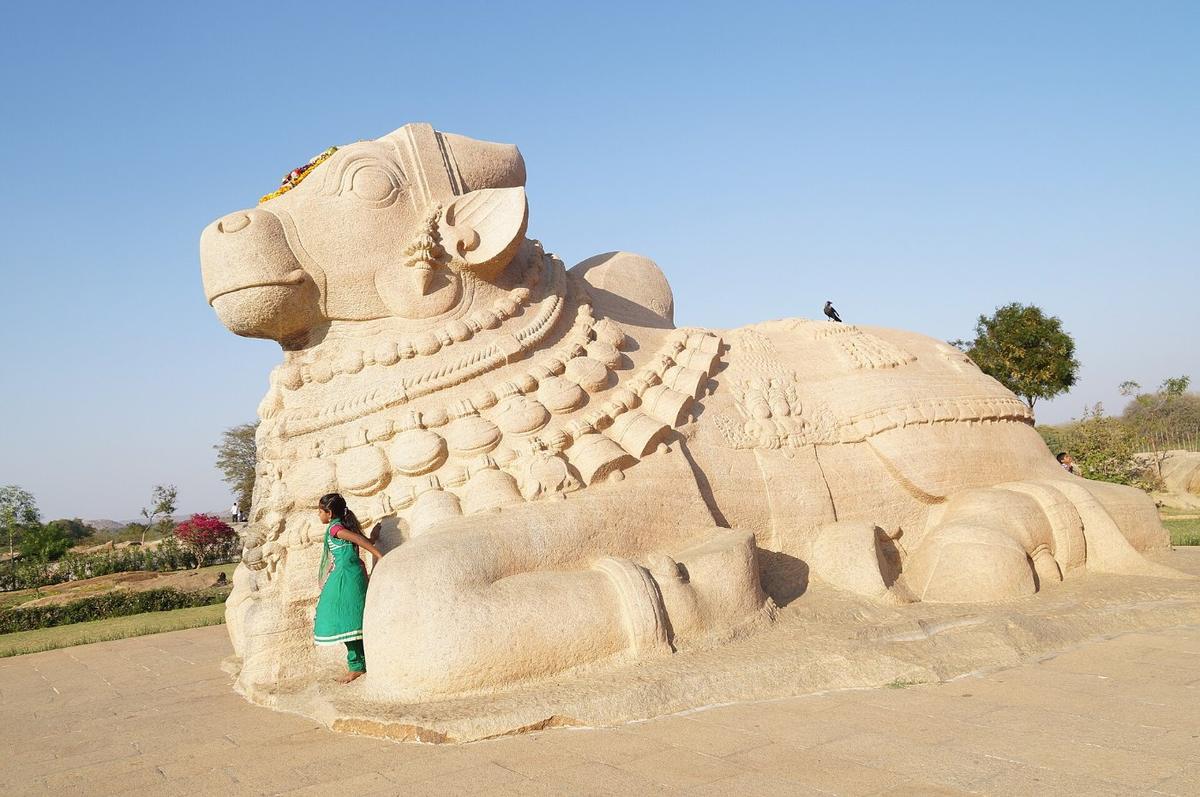
Photo: Lepakshi Nandi, Rahmanuddin, CC BY-SA 4.0

APPSC Group-I Mains 2020 · Paper II
2020 Paper II · Q7(a): model answer
History, Culture & Geography of India and Andhra Pradesh · Ancient and Medieval Andhra. Held in December 2020 (Notification 27/2018).
Write a brief note on the architecture during the period of Vijayanagar Empire.
Syllabus: Ancient and Medieval Andhra · Kakatiyas, Reddis, Gajapatis and Vijayanagara
Raya gopuramKalyana mandapaComposite pillarsIndo-Islamic elements
The Vijayanagara Empire, founded in 1336 by Harihara and Bukka, developed the Dravida temple style into a grand and ornate form, adding towering gateways, many-pillared halls and fine secular buildings. Its capital Hampi is a UNESCO World Heritage Site (1986), and several of its finest monuments, such as Lepakshi, Srikalahasti and Tadipatri, lie in present Andhra Pradesh.
1. Temple architecture
- Raya gopurams: towering gateways came to dwarf the central vimana and announced the temple from a distance; Krishnadevaraya built gopurams at Hampi (Virupaksha), Tiruvannamalai and Srikalahasti.
- Pillared halls: kalyana mandapas with richly carved pillars were built for the divine marriage festival, along with a separate Amman shrine for the goddess.
- Composite pillars: pillars were carved with rearing horses and yalis; the Vitthala temple has musical pillars and a stone chariot.
- Major temples at Hampi: Virupaksha, Vitthala, Hazara Rama (with Ramayana friezes) and Achyutaraya.
- Temple complexes: several enclosure walls (prakaras), chariot streets and festival halls reflected the temple's role in the ritual, economic and urban life of the empire.
| Feature | Chola temple (e.g. Thanjavur) | Vijayanagara temple |
|---|---|---|
| Dominant element | Lofty vimana over the sanctum | Towering gopurams at the entrances |
| Halls | Few mandapas on the main axis | Many pillared halls, including kalyana mandapas |
| Pillars | Relatively plain | Composite, with rearing horses, yalis, musical columns |
| Complex | Centred on one main shrine and its vimana | Separate goddess shrine, many prakaras, chariot streets |
2. Secular architecture
- Indo-Islamic features: the Lotus Mahal and Elephant Stables at Hampi use arches and domes, showing interaction with the Deccan Sultanates.
- Royal and sacred centres: Hampi had a royal centre with the Mahanavami Dibba and Queen's Bath, and a sacred centre of temples.
- Engineering: massive fortifications, aqueducts and stepped tanks reflect urban planning and water management.
3. Andhra examples
- Lepakshi: the Veerabhadra temple (1530s, built by the brothers Virupanna and Viranna under Achyutaraya) has a hanging pillar, a huge monolithic Nandi, a Naga-linga and ceiling murals.
- Gopurams and temples: the Srikalahasti Raja Gopuram (which collapsed in 2010 and has been rebuilt), the Chintala Venkataramana and Bugga Ramalingeswara temples at Tadipatri, and the Ahobilam temples.
- Forts and palaces: Penukonda and Chandragiri (with the Raja Mahal) served as capitals after the battle of 1565.
- Tirumala: Krishnadevaraya made rich gifts to the Venkateswara temple, where statues of him and his two queens still stand.
Schematic map of Andhra Pradesh (2011 census district outlines), not to scale; for study only.
Assessment: The style was eclectic, combining Chalukya, Chola and Hoysala traditions with Indo-Islamic elements in secular buildings, and its gopurams and pillared mandapas were carried forward by the Nayakas of Madurai and Thanjavur.
These monuments form a shared heritage of Andhra Pradesh and Karnataka; their conservation can support heritage tourism and local livelihoods.
The other choice in Q7
Answer either one in the exam.
- Q7(b)"The foundation of Vijayanagara Empire coincided in point of time with the outburst of a momentous literary movement in South India." Discuss it.
10 marks · Ancient and Medieval Andhra · Kakatiyas, Reddis, Gajapatis and Vijayanagara
Every model answer on these pages is free to read. The Tool Kit adds four PDF books for Mains Papers I–IV: every previous question sorted by syllabus, with practice questions. It is in the ₹149 All-in-One Pass, with every previous paper of every exam on the site, practice quizzes, timed tests, mock test series and study books.
₹149 · valid for 12 months from the day you pay, on every exam · pay by UPI, card or net banking