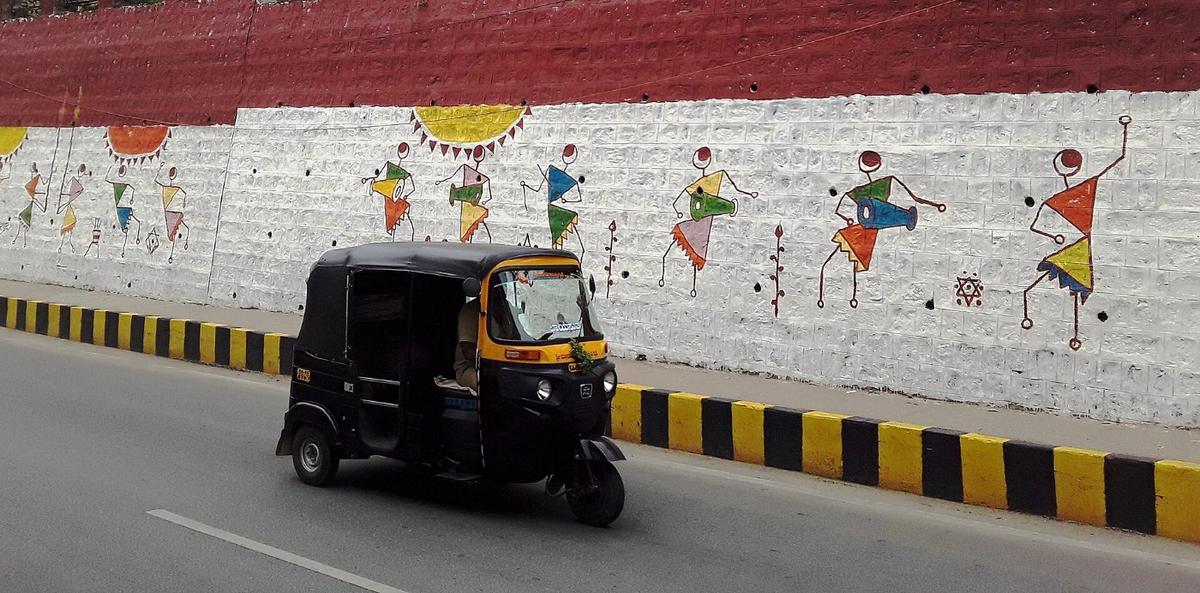
Photo: Warli paintings, Mysuru, Prof tpms, CC BY-SA 4.0

UPSC Civil Services (Main) 2023 · Paper II
UPSC Anthropology Optional 2023 Paper 2 · Q7(a): model answer
Anthropology Paper II: Indian Anthropology: Indian Society, Caste, Village and Tribal India · Tribal Development.
Elucidate the shifting terrains of India's tribal policies in colonial and post-colonial periods.
Syllabus: Tribal Development · History of tribal administration and policies
IsolationAssimilationIntegration (Panchsheel)Rights-based approach
India's tribal policy has crossed several terrains: colonial control and exclusion, a late-colonial debate between isolation and assimilation, Nehru's integration through the Panchsheel, a rights-based turn from the 1990s and, lately, mission-mode schemes to saturate basic services. Each shift reflected a changing view of tribal people: subjects, wards, citizens and right-holders.
1. Colonial period: revenue, forests and exclusion
- Opening the tracts: the Permanent Settlement (1793) and new courts brought landlords, moneylenders and traders ("diku") into tribal lands; the Forest Acts of 1865, 1878 and 1927 made forests state property.
- Revolt and concession: the Kol rising (1831–32) led to the South-West Frontier Agency (1833), the Santhal Hul (1855) to a separate Santhal Parganas district, and Birsa Munda's Ulgulan (1899–1900) to the Chotanagpur Tenancy Act (1908).
- Exclusion: the Inner Line (1873), the Scheduled Districts Act (1874), "backward tracts" (1919) and "excluded" and "partially excluded areas" (1935) kept tribal regions outside normal administration.
2. The late-colonial debate
- Verrier Elwin (The Loss of Nerve, 1941) urged protection from exploitation and hasty change; his early proposal of a protected "national park" for groups such as the Baiga was attacked as isolationist.
- G.S. Ghurye (The Aborigines—"So-called"—and Their Future, 1943) saw tribes as "backward Hindus" who should be assimilated.
| Approach | Advocates | Core idea | Criticism |
|---|---|---|---|
| Isolation | Early Elwin; colonial "excluded areas" | Shield tribes from outsiders | Keeps them as "museum specimens" |
| Assimilation | G.S. Ghurye | Absorb tribes into Hindu society | Erases distinct identity |
| Integration | Nehru's Panchsheel (1959) | Develop without destroying culture | Top-down; development displaces |
| Rights-based | Bhuria Committee; PESA; FRA | Self-rule and rights over resources | Weak enforcement by States |
3. Integration after Independence (1950–1990)
- Constitutional frame: Article 46, the Fifth and Sixth Schedules, grants under Article 275(1), reserved seats and ST lists under Article 342.
- Panchsheel (1959): in his foreword to Elwin's A Philosophy for NEFA, Nehru asked for development along the people's own genius, respect for land and forest rights, training of tribal teams, no over-administration, and judging results by human character rather than money spent.
- Programmes: Multipurpose Tribal Blocks (1954), Tribal Development Blocks after the Elwin (1959) and Dhebar (1960–61) reviews, the Tribal Sub-Plan with Integrated Tribal Development Projects from the Fifth Plan (1974–75), and special help for primitive tribal groups from 1975 (now 75 PVTGs).
- Contradiction: dams, mines and forest policy displaced lakhs of tribal people, making development a source of alienation.
4. Rights-based turn (1990s–2010s)
- Self-rule and rights: PESA (1996), on the Bhuria Committee's advice, empowered gram sabhas in Scheduled Areas; the Forest Rights Act (2006) recognised individual and community forest rights and acknowledged a "historical injustice".
- Institutions and courts: a Ministry of Tribal Affairs (1999), a separate National Commission for STs (Article 338A, 2003), and judgments such as Samatha (1997) and Niyamgiri (2013); the Xaxa Committee (2014) found land loss and weak implementation persisting.
5. Recent phase
- Saturation schemes: PM-JANMAN (2023, about ₹24,000 crore for PVTG habitations) and the Dharti Aaba Janjatiya Gram Utkarsh Abhiyan (2024, ₹79,156 crore for over 63,000 tribal villages); Janjatiya Gaurav Divas (15 November) since 2021.
- Tension: critics see a return to top-down delivery and a dilution of forest safeguards through the Forest (Conservation) Amendment Act, 2023.
- 1793 Permanent Settlement opens tribal tracts
- 1855 Santhal Hul; Santhal Parganas created
- 1908 Chotanagpur Tenancy Act
- 1935 Excluded and partially excluded areas
- 1950 Fifth and Sixth Schedules in force
- 1959 Nehru's Panchsheel
- 1974–75 Tribal Sub-Plan and ITDPs
- 1996 PESA
- 2006 Forest Rights Act
- 2023–24 PM-JANMAN; Dharti Aaba Abhiyan
The terrain has shifted from control to rights, but the tension between national development and tribal autonomy persists. Policy will succeed when gram sabhas, not distant offices, decide how development reaches tribal homelands.
The other parts of Q7
- Q7(b)Critically examine how the displacement of tribal communities due to hydroelectric river dam projects has affected the women in local context. Illustrate with suitable ethnographic examples.
15 marks · Problems of Tribal Communities · Displacement and rehabilitation
- Q7(c)Elucidate the role of anthropology in nation building. Illustrate with suitable examples.
15 marks · Tribal Development · Role of NGOs and anthropology in development
The ₹149 All-in-One Pass opens the rest of the site for 12 months: UPSC Prelims GS Paper I and CSAT with explanations, practice quizzes and timed tests, UPSC CAPF and EPFO, the previous papers of every APPSC, TSPSC, police and SSC exam, every mock test series and the study books.
₹149 · valid for 12 months from the day you pay, on every exam · pay by UPI, card or net banking