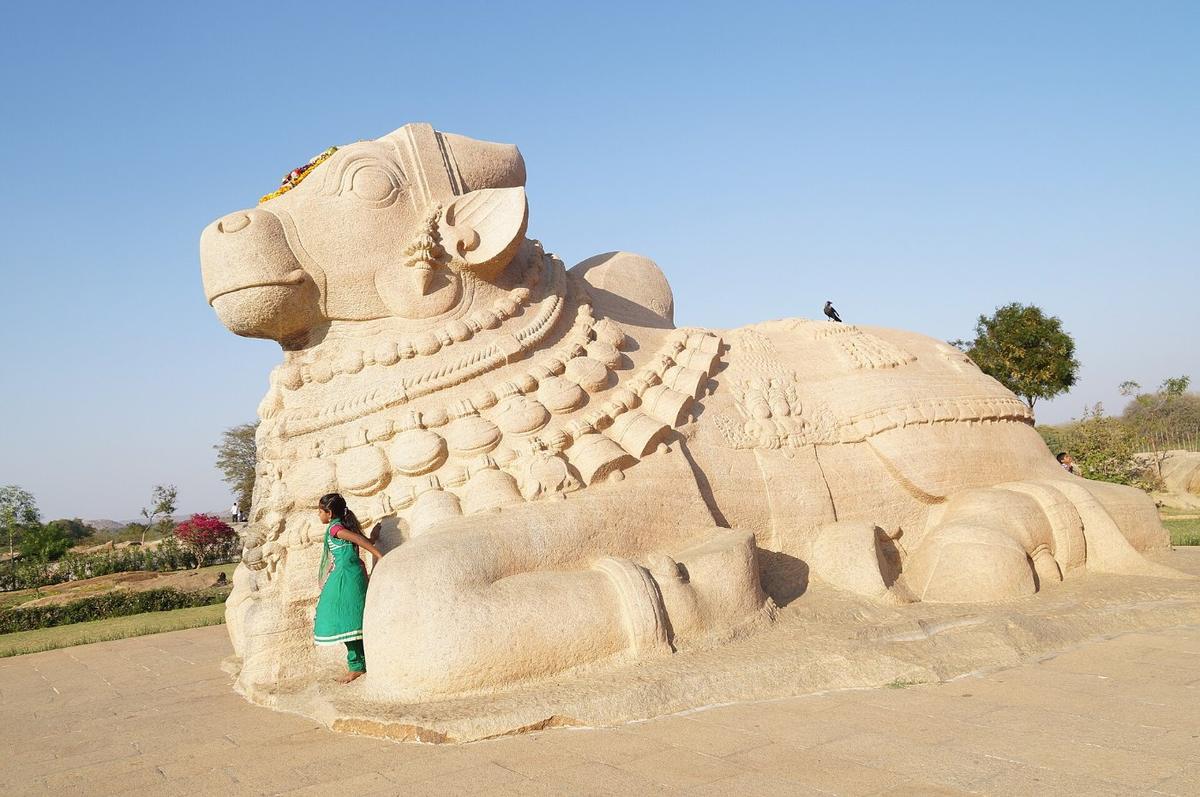
Photo: Lepakshi Nandi, Rahmanuddin, CC BY-SA 4.0

APPSC Group-I Mains 2025 · Paper II
2025 Paper II · Q8(b): model answer
History, Culture & Geography of India and Andhra Pradesh · Ancient and Medieval Andhra. Held in May 2025 (Notification 12/2023).
Discuss the significance of the Warangal Fort complex as a historical monument.
Syllabus: Ancient and Medieval Andhra · Kakatiyas, Reddis, Gajapatis and Vijayanagara
Warangal FortKakatiya architectureKirti ToranasTelugu heritage
The Warangal Fort at Orugallu (Ekasilanagaram), the capital of the Kakatiyas, was begun by Ganapatideva (1199–1262) and completed by Rudramadevi and Prataparudra in the 13th century. Built around a single rock hill (Ekashila) that gave the city its name, it was one of the strongest forts of medieval South India. Today it is a symbol of Telugu political unity, military engineering and Kakatiya art.
1. Features of the fort
- Concentric defences: an inner wall of large dressed granite blocks with bastions, a middle earthen wall and an outer earthen rampart, each with moats.
- Kirti Toranas: four ornate stone gateways, facing the four directions, around the ruined Svayambhu Shiva temple.
- Other remains: scattered sculptures and temple ruins, the Ekashila hillock and the later Khush Mahal.
2. Significance as a historical monument
- Political: it was the capital of the first dynasty to unite the Telugu lands, from coastal Andhra (Motupalli port) to Telangana; Rudramadevi ruled from here, and Marco Polo, who visited Motupalli, praised her rule.
- Military history: Malik Kafur, Alauddin Khalji's general, besieged it in 1309–10 and Prataparudra paid tribute; Ulugh Khan (later Muhammad bin Tughlaq) captured it in 1323, ending Kakatiya rule; Amir Khusrau described its mud and stone walls.
- Architecture: it is a fine example of medieval military engineering, and its toranas display the Kakatiya stone carving also seen at Ramappa.
- Identity: the Kakatiya Kala Thoranam was placed in Telangana's State emblem in 2014.
- Heritage status: the fort, with the Thousand Pillar and Ramappa temples, is on UNESCO's tentative list as "The Glorious Kakatiya Temples and Gateways" (Ramappa was inscribed in 2021); Warangal was selected under the HRIDAY heritage city scheme (2015).
- Tourism: the fort is part of a Kakatiya heritage circuit with Hanamkonda and Ramappa, supporting local livelihoods.
- Legacy: the fall of Warangal led to the Musunuri Nayakas' struggle for liberation and influenced the rise of Vijayanagara.
- 1199–1262 Ganapatideva begins the stone fort
- 13th century Rudramadevi and Prataparudra complete it
- 1309–10 Siege by Malik Kafur; Prataparudra pays tribute
- 1323 Captured by Ulugh Khan; end of Kakatiya rule
- 2015 Warangal chosen under the HRIDAY scheme
- 2021 Ramappa temple inscribed as a World Heritage Site
AP angle: For Andhra Pradesh, the fort recalls an age when coastal Andhra and Telangana formed one Kakatiya kingdom, with Motupalli on the Andhra coast as its port; it is a shared heritage of both Telugu States.
The fort, a shared heritage of all Telugu people, symbolises political unity, military engineering and Kakatiya art; scientific conservation and heritage tourism can preserve it for future generations.
The other choice in Q8
Answer either one in the exam.
- Q8(a)Discuss the growth of various Saivite sects during the Kakatiya rule.
10 marks · Ancient and Medieval Andhra · Kakatiyas, Reddis, Gajapatis and Vijayanagara
Every model answer on these pages is free to read. The Tool Kit adds four PDF books for Mains Papers I–IV: every previous question sorted by syllabus, with practice questions. It is in the ₹149 All-in-One Pass, with every previous paper of every exam on the site, practice quizzes, timed tests, mock test series and study books.
₹149 · valid for 12 months from the day you pay, on every exam · pay by UPI, card or net banking