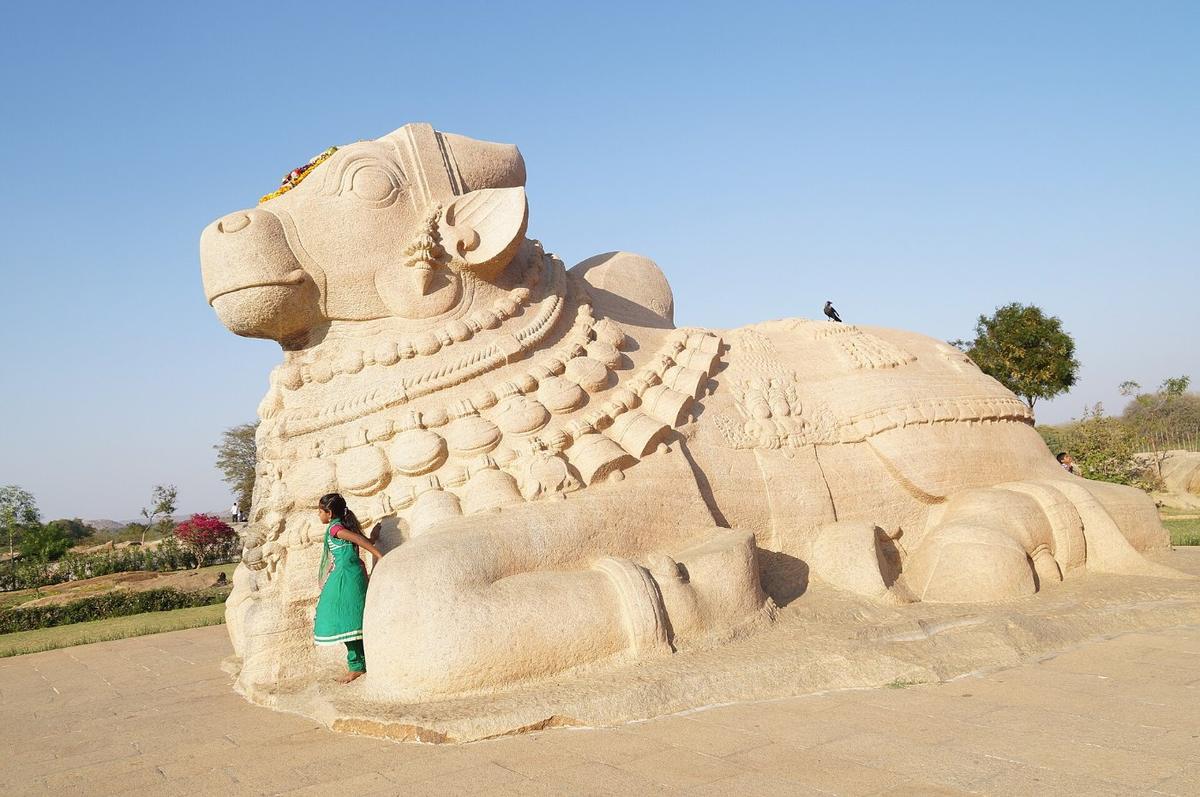
Photo: Lepakshi Nandi, Rahmanuddin, CC BY-SA 4.0

APPSC Group-I Mains 2023 · Paper II
2023 Paper II · Q3(a): model answer
History, Culture & Geography of India and Andhra Pradesh · Medieval India. Held in June 2023 (Notification 28/2022).
Discuss the features of Mughal architecture and examine the influence of Hindu elements on Mughal architecture.
Syllabus: Medieval India · Mughals, Shivaji and the Marathas
Indo-Islamic synthesisCharbagh and double domeTrabeate elementsAkbar and Shah Jahan
Mughal architecture (16th–17th centuries) blended Persian-Timurid forms with indigenous Rajput, Gujarati and Hindu building traditions. It began with Humayun's Tomb, matured in red sandstone under Akbar, and reached its peak in white marble under Shah Jahan, producing an Indo-Islamic synthesis that reflected the composite culture of the empire.
- c. 1572 Humayun's Tomb, Delhi, completed: first great garden tomb
- 1571–1585 Fatehpur Sikri, Akbar's red-sandstone capital
- 1622–1628 Itimad-ud-Daula's tomb, Agra: white marble with pietra dura
- 1632–1653 Taj Mahal, Agra
- 1639–1648 Red Fort, Shahjahanabad (Delhi)
- 1673 Badshahi Mosque, Lahore (Aurangzeb)
1. Features of Mughal architecture
- Timurid-Persian forms: bulbous double domes, iwans (lofty arched portals) and the charbagh garden divided into four by water channels; Humayun's Tomb (architect Mirak Mirza Ghiyas) set the model.
- Materials: red sandstone under Akbar (Agra Fort, Fatehpur Sikri); white marble with pietra dura inlay under Jahangir and Shah Jahan (Itimad-ud-Daula's tomb, Taj Mahal).
- Symmetry and ornament: perfect symmetry and axial planning, tall minarets, calligraphy, floral and geometric ornament, and pierced stone screens (jalis).
- Garden setting: unlike Humayun's Tomb, which stands at the centre of its charbagh, the Taj Mahal stands at the river end of the garden on the Yamuna, flanked by a mosque and a guest house.
- Fort-palaces and cities: Fatehpur Sikri with the Buland Darwaza; Shahjahanabad with the Red Fort and Jama Masjid.
- Decline: under Aurangzeb building slowed; the Bibi-ka-Maqbara at Aurangabad is a modest imitation of the Taj.
2. Influence of Hindu and indigenous elements
- Trabeate construction: pillars, beams and brackets dominate Fatehpur Sikri, as in Jodha Bai's palace, the Diwan-i-Khas with its carved central pillar, and the tiered, pillared Panch Mahal.
- Rajput features: chhatris (domed kiosks), chhajjas (sloping eaves) and serpentine brackets were drawn from Rajput and Gujarati palaces.
- Hindu motifs: the kalasha finial and the inverted lotus crown the domes of Humayun's Tomb and the Taj Mahal; lotus motifs and carved Hindu-style brackets appear in the Jahangiri Mahal, Agra Fort.
- Craftsmen and policy: Akbar's sulh-i-kul, Rajput alliances and the employment of Gujarati and Rajasthani craftsmen made this synthesis possible.
| Element | Source tradition | Example |
|---|---|---|
| Trabeate pillars and brackets | Hindu temples, Rajput palaces | Diwan-i-Khas, Panch Mahal (Fatehpur Sikri) |
| Chhatris | Rajput architecture | Roofs of Humayun's Tomb and the Taj Mahal |
| Chhajjas and serpentine brackets | Gujarati and Rajput palaces | Jahangiri Mahal, Agra Fort |
| Kalasha and inverted-lotus finial | Crowning of Hindu temples | Domes of Humayun's Tomb and the Taj Mahal |
3. Assessment
- Phases of synthesis: the Hindu element was strongest under Akbar; under Shah Jahan Persian elegance dominated, but chhatris and lotus finials remained.
- Legacy: Mughal forms shaped later Rajput palaces and, much later, the colonial Indo-Saracenic style.
Deccan/AP angle: the Qutb Shahis of Golconda, who also ruled coastal Andhra, developed a parallel Indo-Islamic style; Mughal influence spread after Aurangzeb annexed Golconda in 1687.
Mughal architecture embodies India's composite culture; Humayun's Tomb, the Taj Mahal, Agra Fort, Fatehpur Sikri and the Red Fort Complex are UNESCO World Heritage Sites.
The other choice in Q3
Answer either one in the exam.
- Q3(b)'The state that was [illegible] Shivaji was not only egalitarian in conception but also a welfare state in nature.' Examine.
10 marks · Medieval India · Mughals, Shivaji and the Marathas
Every model answer on these pages is free to read. The Tool Kit adds four PDF books for Mains Papers I–IV: every previous question sorted by syllabus, with practice questions. It is in the ₹149 All-in-One Pass, with every previous paper of every exam on the site, practice quizzes, timed tests, mock test series and study books.
₹149 · valid for 12 months from the day you pay, on every exam · pay by UPI, card or net banking