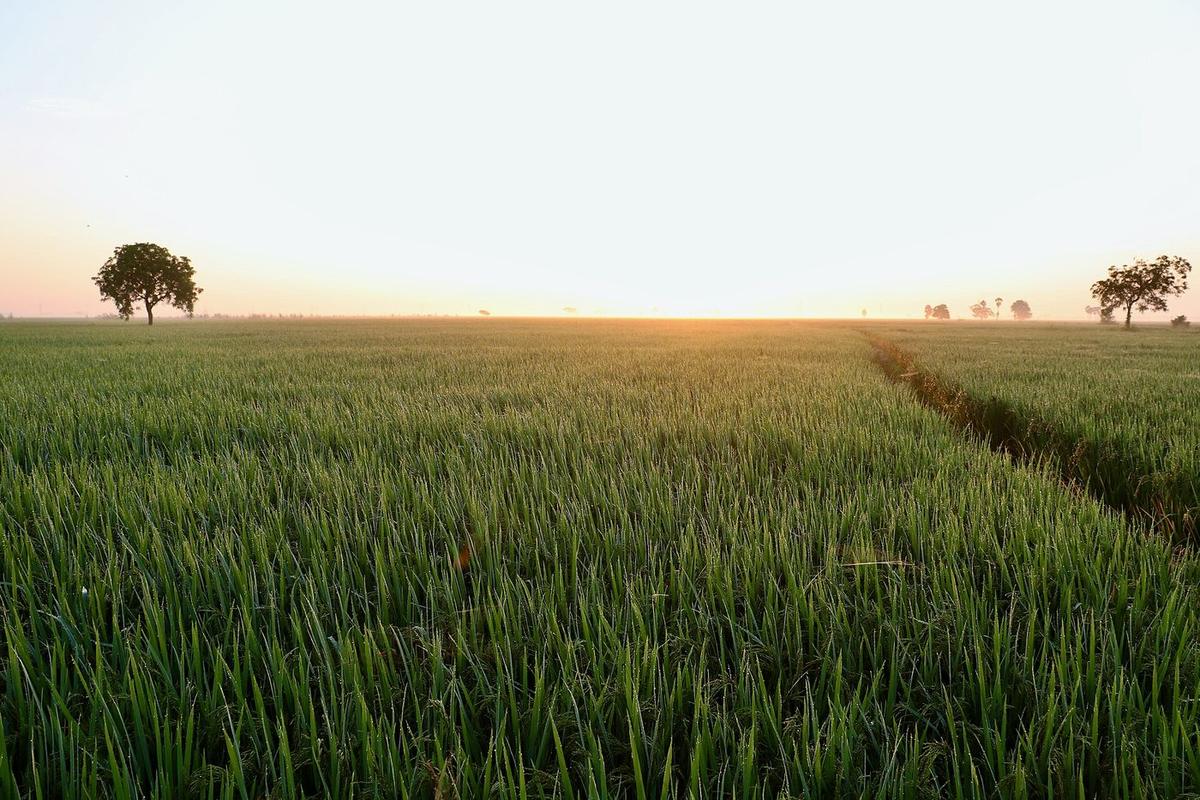
Photo: Paddy fields near Eluru, iMahesh, CC BY-SA 4.0

APPSC Group-I Mains 2020 · Paper IV
2020 Paper IV · Q1(b): model answer
Economy & Development of India and Andhra Pradesh · India's big economic problems. Held in December 2020 (Notification 27/2018).
Highlight some of the major factors leading to low agricultural productivity in India.
Syllabus: India's big economic problems · Why farming and factories grow slowly (and what is being done)
Agricultural productivityFragmented holdingsRain-fed farmingInput and market constraints
Agriculture employs about 46% of India's workers (PLFS 2023-24) but produces less than one-fifth of GVA, which shows low productivity per hectare and per worker. Yields of rice, wheat and pulses are well below those of China and the world leaders. The Green Revolution raised yields mainly in irrigated pockets, while large dryland areas lagged. The causes are structural, technological and institutional, and they reinforce one another.
1. Structural factors
- Small, fragmented holdings: the average holding is 1.08 ha, and 86% of holdings are small or marginal (Agriculture Census 2015-16). Tiny, scattered plots make tractors, harvesters and borewells uneconomical.
- Population pressure: too many people depend on the land, so disguised unemployment keeps output per worker low.
- Insecure tenancy: oral leases leave tenants without bank credit, crop insurance or input subsidies, and without any incentive to invest in land improvement.
- Low capital formation: public investment in irrigation, drainage and rural infrastructure has lagged behind spending on input subsidies.
2. Technological factors
- Dependence on the monsoon: nearly half of the net sown area is rain-fed, so a delayed or weak monsoon lowers yields across the dryland belt.
- Poor inputs: low seed replacement rates, and urea-biased fertiliser use (driven by the subsidy) that is far from the recommended 4:2:1 NPK balance and degrades soil health.
- Weak research and extension: low spending on agricultural R&D and too few extension workers, so new varieties and practices spread slowly.
- Low mechanisation on small farms, and little use of precision or protected cultivation.
| Factor | Effect on productivity | Remedy |
|---|---|---|
| Small holdings (1.08 ha) | Little mechanisation or investment | FPOs, custom hiring centres, land-leasing laws |
| Rain-fed farming | Yields swing with the monsoon | PMKSY micro-irrigation, watershed development |
| Urea-biased fertiliser use | Soil degradation | Soil Health Cards, balanced nutrients |
| Low seed replacement | Old, low-yield varieties | Quality and climate-resilient seeds |
| Weak credit and markets | Low investment, distress sales | Kisan Credit Cards, e-NAM, warehouse receipts |
3. Institutional and market factors
- Inadequate institutional credit: small and tenant farmers still depend on moneylenders at high interest.
- Post-harvest losses and volatile prices: poor storage and cold chains, and price crashes that discourage investment in better inputs.
- Climate change: heat waves, erratic rain and new pests reduce and destabilise yields.
4. Andhra Pradesh angle
The Godavari–Krishna deltas have some of India's highest paddy yields, but rain-fed Rayalaseema, especially drought-prone Anantapur, has low yields. Many delta farmers are tenants, so the AP Crop Cultivators Rights Act, 2019 gives them cards to obtain credit.
Way forward: micro-irrigation (PMKSY, "more crop per drop"), Soil Health Cards, quality seeds, digital agriculture (AgriStack), FPOs and climate-resilient varieties can raise productivity sustainably, a second Green Revolution that is also ecologically sound.
The other choice in Q1
Answer either one in the exam.
- Q1(a)State some of the notable initiatives taken by the government recently to boost the growth of manufacturing sector in India.
10 marks · India's big economic problems · Why farming and factories grow slowly (and what is being done)
Every model answer on these pages is free to read. The Tool Kit adds four PDF books for Mains Papers I–IV: every previous question sorted by syllabus, with practice questions. It is in the ₹149 All-in-One Pass, with every previous paper of every exam on the site, practice quizzes, timed tests, mock test series and study books.
₹149 · valid for 12 months from the day you pay, on every exam · pay by UPI, card or net banking