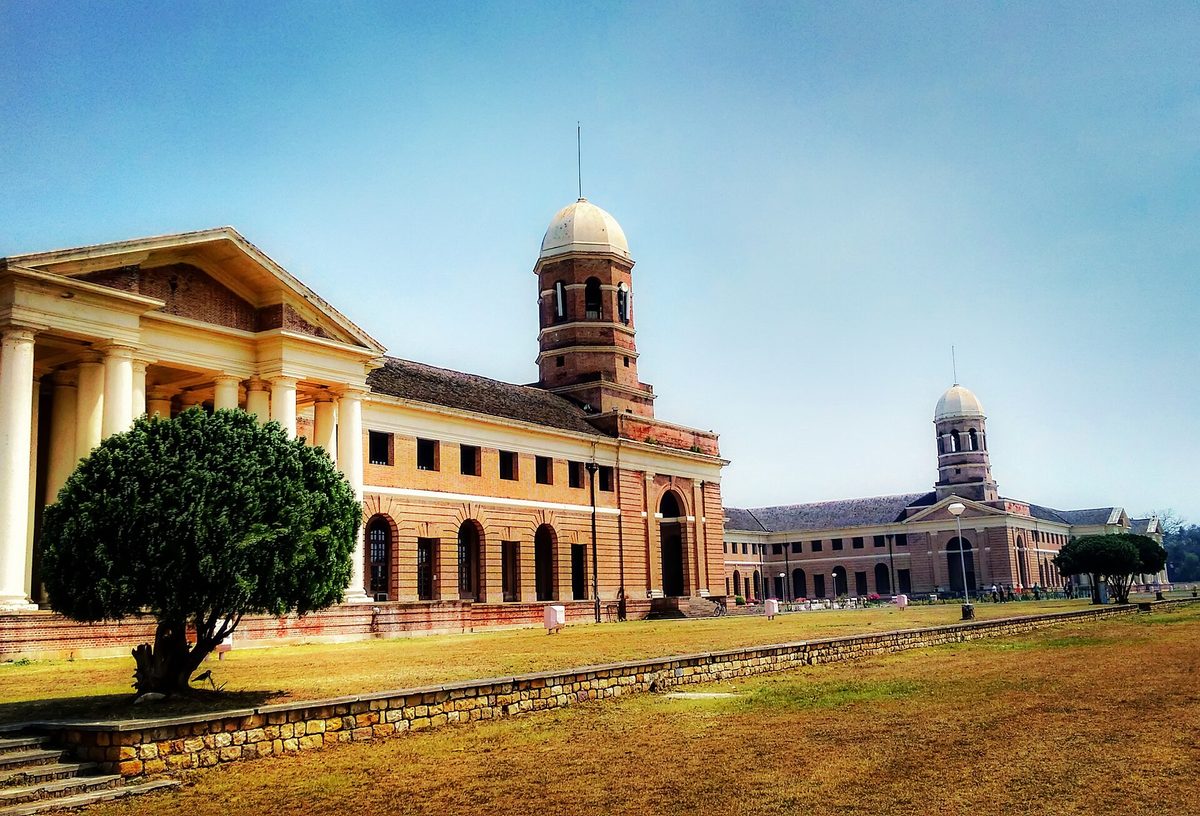
Photo: Forest Research Institute, Dehradun, Mrigank Das, CC BY-SA 4.0

UPSC Indian Forest Service (Main) 2025 · General English
UPSC IFoS Mains 2025 General English · Q1(b): model answer
General English: Essay, Letter or Report, Précis, Comprehension and Grammar · Essay.
Write an essay in about 800 – 1000 words on any one of the following : Wildlife preservation and the development drive
Syllabus: Essay · Essay
DevelopmentWildlifeCoexistenceSustainable growth
Wildlife Preservation and the Development Drive
India is one of the world's seventeen mega-diverse countries. With only 2.4% of the world's land, it holds about 7–8% of recorded species, including the largest populations of wild tigers and Asian elephants. India is also the world's most populous country and one of the fastest-growing major economies, building roads, railways, dams, mines and cities at great speed. The question of our time is whether these two facts can live together.
Why development presses on wildlife
Development needs land, water and energy. Highways and railway lines cut through forests and elephant corridors; hundreds of elephants have died on railway tracks in recent decades. Mining for coal, iron and bauxite removes forests in central India, the heart of tiger and elephant habitat. Dams submerge valleys, and urban growth swallows wetlands and grasslands. Habitat loss and fragmentation, rather than hunting, are now the biggest threats to wildlife. When habitats shrink, human–wildlife conflict rises: leopards in Mumbai's suburbs, elephants in Kerala's villages and tigers near farms in Maharashtra.
Why wildlife matters for development
Wildlife is not a luxury standing in the way of growth. Forests and wild areas provide water for rivers and cities, protect soil, store carbon and pollinate crops. Kaziranga's floodplains, the Sundarbans' mangroves and the Western Ghats' forests protect millions of people from floods, cyclones and drought. Wildlife tourism supports local jobs. Development that destroys these services is not development at all; it simply shifts costs onto the poor and the future.
India's record
India has shown that conservation can succeed even with large populations. Project Tiger (1973) has helped tiger numbers rise to over 3,600 (2022 estimate), about three-quarters of the world's wild tigers. The Asiatic lion has recovered in Gir; the one-horned rhino in Kaziranga. Laws such as the Wildlife (Protection) Act, 1972 and the Forest Conservation Act, 1980, and a network of over a thousand protected areas, provide a strong base.
But there are worries. Amendments to forest laws in 2023, fast-tracked clearances and diversion of forest land for projects have raised concerns about weaker scrutiny. Projects such as the Ken–Betwa river link will submerge part of the Panna Tiger Reserve; the Great Nicobar project will clear tropical forest in a biodiversity-rich island. The challenge is not whether to develop but how.
Reconciling the two
The answer lies in smart, sustainable development:
- Avoid, minimise, mitigate: avoid the most valuable habitats, and route roads and rail lines around them.
- Green infrastructure: animal underpasses and overpasses, as on NH-44 through the Pench landscape, and speed limits on railway lines in elephant corridors.
- Landscape planning: protect corridors that link reserves, not just islands of forest.
- Honest environmental impact assessment with public hearings and independent monitoring.
- Community partnership: recognise forest rights, share tourism revenue, and pay quick compensation for crop and livestock losses, so that local people become guardians of wildlife.
- Compensatory afforestation that restores real ecosystems, not monoculture plantations.
Conclusion
Gandhi said the earth provides enough to satisfy every man's need, but not every man's greed. Wildlife preservation and development are not enemies; both aim at a better life for people. A growing India must build infrastructure, but it must build with care, so that the tiger, the elephant and the forests that sustain us all survive into the India of 2047.
The other parts of Q1
- Q1(a)Write an essay in about 800 – 1000 words on any one of the following : Childhood in conflict zones
100 marks · 1000 words · Essay · Essay
- Q1(c)Write an essay in about 800 – 1000 words on any one of the following : Freedom in the age of digital surveillance
100 marks · 1000 words · Essay · Essay
- Q1(d)Write an essay in about 800 – 1000 words on any one of the following : Impact of Artificial Intelligence on employment sector
100 marks · 1000 words · Essay · Essay
The ₹149 All-in-One Pass opens the rest of the site for 12 months: UPSC Prelims GS Paper I and CSAT with explanations, practice quizzes and timed tests, UPSC CAPF and EPFO, the previous papers of every APPSC, TSPSC, police and SSC exam, every mock test series and the study books.
₹149 · valid for 12 months from the day you pay, on every exam · pay by UPI, card or net banking