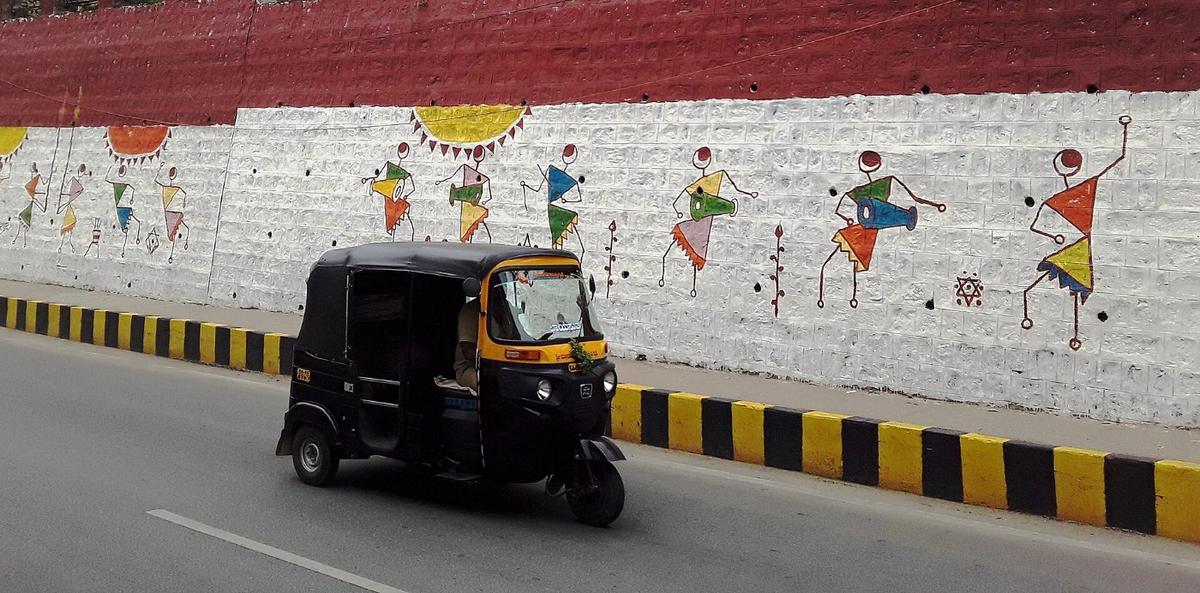
Photo: Warli paintings, Mysuru, Prof tpms, CC BY-SA 4.0

UPSC Civil Services (Main) 2024 · Paper II
UPSC Anthropology Optional 2024 Paper 2 · Q4(b): model answer
Anthropology Paper II: Indian Anthropology: Indian Society, Caste, Village and Tribal India · Tribe-State Relations, Ethnicity and Movements.
Write an essay on the life history of tribal activist and freedom fighter Birsa Munda. What was the impact of his sacrifice on tribal society?
Syllabus: Tribe-State Relations, Ethnicity and Movements · Tribal movements and identity
Birsa MundaUlgulanKhuntkattiRevitalisation movement
Birsa Munda (1875–1900), revered as Dharti Aba (father of the earth), led the Ulgulan (great tumult) of the Mundas of Chotanagpur. His movement joined religious reform, agrarian protest and political assertion against dikus (outside landlords and moneylenders), missionaries and British rule. K.S. Singh's The Dust-Storm and the Hanging Mist (1966) remains its classic study.
1. Early life
- Birth: born on 15 November 1875 at Ulihatu (now in Khunti district, Jharkhand) into a poor Munda family that moved from village to village in search of work.
- Education: studied at the German Lutheran mission school at Chaibasa and briefly became a Christian, but broke with the missionaries over their attitude to the Munda land struggle.
- Influences: learnt Vaishnava ideas from Anand Panre and came into contact with the Sardar agitation (mulkai larai), which since the mid-nineteenth century had sought Munda land rights through petitions and courts.
2. Prophet and reformer (1895)
- New faith: in 1895 he declared himself a messenger of Singbonga, the supreme god, and gathered followers known as Birsaites.
- Teachings: belief in one god, giving up liquor, animal sacrifice and fear of witchcraft, cleanliness and wearing the sacred thread, a blend of Munda, Hindu and Christian ideas.
- Politics: he called for an end to the rule of the dikus and the British and the return of the Mundas' own rule; arrested in 1895, he spent two years in jail.
3. The Ulgulan (1899–1900)
- Causes: the breakdown of khuntkatti, the joint ownership of land by the lineage of the original clearers, as jagirdars and thikadars took over villages; forced labour (beth-begari), rising rents, moneylenders and forest restrictions.
- Course: around Christmas Eve 1899 his followers attacked churches, police stations and landlords' property around Khunti, Ranchi and Singhbhum; in January 1900 troops fired on Mundas gathered at Dombari Buru.
- End: captured in February 1900, Birsa died in Ranchi jail on 9 June 1900, aged about twenty-five.
- 1875 Born at Ulihatu (15 November)
- 1895 Proclaims a new faith; jailed for two years
- 1899 Ulgulan begins around Christmas Eve
- 1900 Dombari Buru firing; dies in Ranchi jail (9 June)
- 1908 Chotanagpur Tenancy Act protects khuntkatti
- 2000 Jharkhand formed on his birth anniversary
- 2021 15 November declared Janjatiya Gaurav Divas
- 2024–25 150th birth anniversary: Janjatiya Gaurav Varsh
4. Impact of his sacrifice on tribal society
- Land protection: survey and settlement operations recorded khuntkatti rights, and the Chotanagpur Tenancy Act, 1908 restricted the transfer of tribal land to non-tribals; it remains a key shield for Adivasi land.
- Identity and pride: the Birsaite faith survives, the movement anticipated later reformist movements such as the Tana Bhagats (1914), and it inspired the Jharkhand movement; the State was created on his birth anniversary in 2000.
- National recognition: his portrait hangs in Parliament, 15 November is observed as Janjatiya Gaurav Divas, and his 150th birth anniversary year (2024–25) was celebrated as Janjatiya Gaurav Varsh; PM-JANMAN was launched at Khunti on 15 November 2023.
- Anthropological meaning: a revitalisation movement in Anthony Wallace's sense (1956) and a messianic one in Stephen Fuchs's Rebellious Prophets (1965), it shows tribal religion becoming a vehicle of reform and resistance.
Birsa's short life turned Munda grievances into a movement for land, dignity and self-rule. The CNT Act and Jharkhand's statehood are his living legacy, and today's debates over land and forest rights keep his call for abua raj (our own rule) relevant.
The other parts of Q4
- Q4(a)What are the ethical concerns in biological and socio-cultural anthropology because of recent advances in AI and genetic research?
20 marks · Anthropology in India · Emergence and growth of anthropology in India
- Q4(c)What are the demographic challenges of India's changing population dynamics in the next 50 years?
15 marks · Demographic Profile of India · Population distribution and growth
The ₹149 All-in-One Pass opens the rest of the site for 12 months: UPSC Prelims GS Paper I and CSAT with explanations, practice quizzes and timed tests, UPSC CAPF and EPFO, the previous papers of every APPSC, TSPSC, police and SSC exam, every mock test series and the study books.
₹149 · valid for 12 months from the day you pay, on every exam · pay by UPI, card or net banking