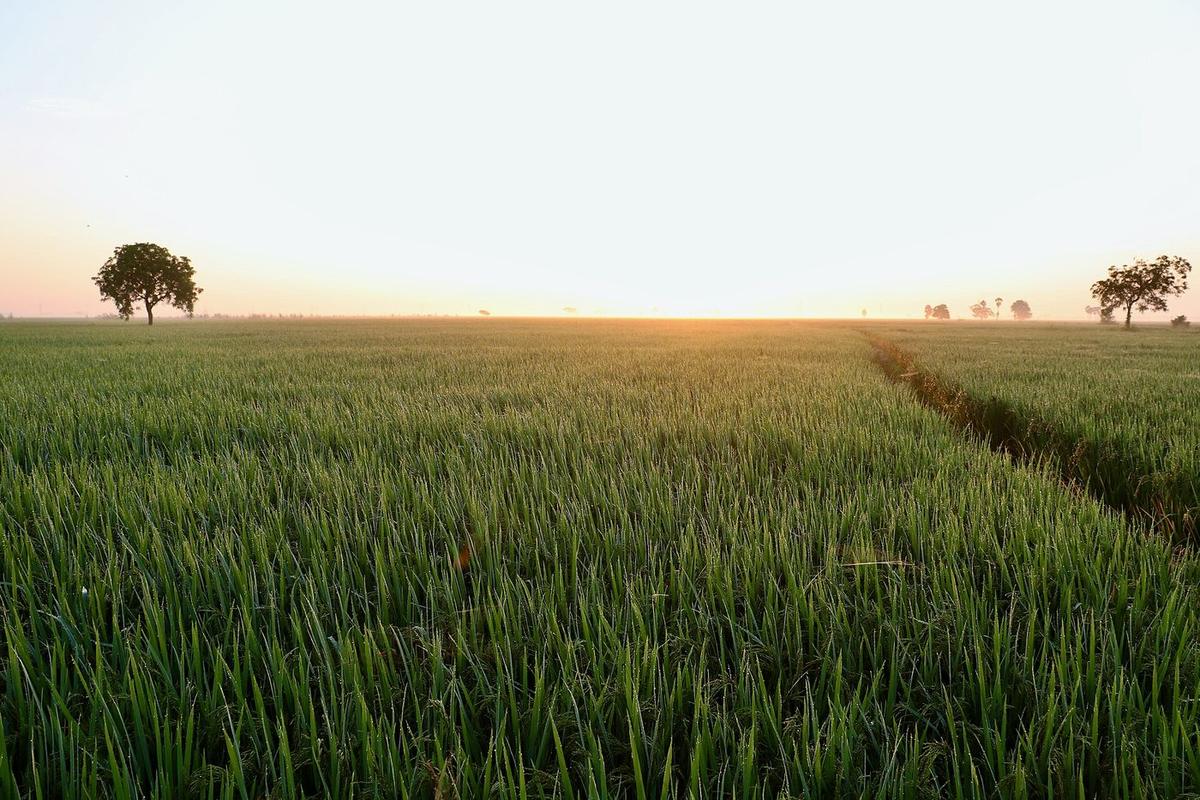
Photo: Paddy fields near Eluru, iMahesh, CC BY-SA 4.0

APPSC Group-I Mains 2025 · Paper IV
2025 Paper IV · Q8(b): model answer
Economy & Development of India and Andhra Pradesh · Farming and allied sectors (India and AP). Held in May 2025 (Notification 12/2023).
Explain the concept of sustainable agriculture. What are its key objectives and common practices in India ?
Syllabus: Farming and allied sectors (India and AP) · From the green revolution to sustainable and organic farming
Sustainable agricultureSoil healthNatural farmingClimate resilience
Sustainable agriculture is farming that meets present food and livelihood needs without degrading soil, water and biodiversity for future generations: it must be economically viable, ecologically sound and socially just. The Green Revolution raised output but left falling water tables, degraded soils and heavy chemical use in many regions. India institutionalised the shift through the National Mission for Sustainable Agriculture (2014-15) under the National Action Plan on Climate Change (2008).
1. Key objectives
- Food and income security: stable yields and higher farm incomes through lower costs and better prices.
- Resource conservation: protect soil health, groundwater and biodiversity, including pollinators and local seed varieties.
- Climate resilience: adapt to droughts, floods and heat, and cut emissions such as methane from flooded paddy and nitrous oxide from fertilisers.
- Lower input dependence: reduce the use of chemical fertilisers and pesticides and their health effects.
- Equity: reach small and marginal farmers, who hold 86% of holdings (Agriculture Census 2015-16).
2. Common practices in India
| Practice | What it involves | Scheme or example |
|---|---|---|
| Soil health management | Integrated nutrient management, bio-fertilisers, green manure | Soil Health Cards (2015), neem-coated urea |
| Integrated pest management | Bio-pesticides, traps, natural enemies of pests | Central Integrated Pest Management Centres |
| Organic and natural farming | No synthetic chemicals; on-farm inputs | PKVY (2015); MOVCDNER (Sikkim fully organic, 2016); National Mission on Natural Farming (2024, 1 crore farmers) |
| Water-use efficiency | Drip and sprinkler irrigation, System of Rice Intensification, watersheds | PMKSY 'Per Drop More Crop' |
| Conservation agriculture | Zero tillage, residue retention, rotation with pulses | Crop-residue management; millets promotion |
| Integrated farming and agroforestry | Crop–livestock–fish systems, trees on farms | Climate-resilient seed varieties |
- Diversification: shifting from water-guzzling paddy and sugarcane to millets, pulses and oilseeds in water-stressed areas.
- Integrated farming systems: combining crops, livestock and fish recycles nutrients and spreads risk.
- Rainwater harvesting and watersheds: farm ponds, check dams and watershed development recharge groundwater in rain-fed areas, which make up about half of the net sown area.
- On-farm bio-inputs: compost, vermicompost and other farm-made preparations used in natural farming cut cash costs and improve soil organic matter.
3. Challenges
- Transition costs: yields may dip in the first years of organic or natural farming, and certification and premium markets are limited.
- Distorted incentives: subsidised urea and free power encourage overuse of fertiliser and groundwater.
- Weak extension: knowledge-intensive practices need trained field staff and farmer-to-farmer learning.
- Market linkages: without certification, aggregation and price premiums, farmers have little reason to give up familiar input-intensive methods.
AP angle: AP Community-managed Natural Farming (APCNF, 2016), run by Rythu Sadhikara Samstha, promotes chemical-free farming and pre-monsoon dry sowing and won the Gulbenkian Prize for Humanity in 2024; AP was also an early leader in drip irrigation through the AP Micro Irrigation Project (2003).
Scaling up these practices through FPOs, extension and fair prices can raise incomes while protecting natural resources, in line with SDG 2 and SDG 13.
The other choice in Q8
Answer either one in the exam.
- Q8(a)Examine the concept of 'Financial Inclusion' and its critical role in fostering inclusive growth in India. Discuss the key initiatives undertaken to promote financial inclusion and evaluate their impact on bringing the unbanked and underbanked populations into the formal financial system.
10 marks · Growth for everyone (inclusive growth) · Banking for all (financial inclusion), SHGs and DWCRA
Every model answer on these pages is free to read. The Tool Kit adds four PDF books for Mains Papers I–IV: every previous question sorted by syllabus, with practice questions. It is in the ₹149 All-in-One Pass, with every previous paper of every exam on the site, practice quizzes, timed tests, mock test series and study books.
₹149 · valid for 12 months from the day you pay, on every exam · pay by UPI, card or net banking