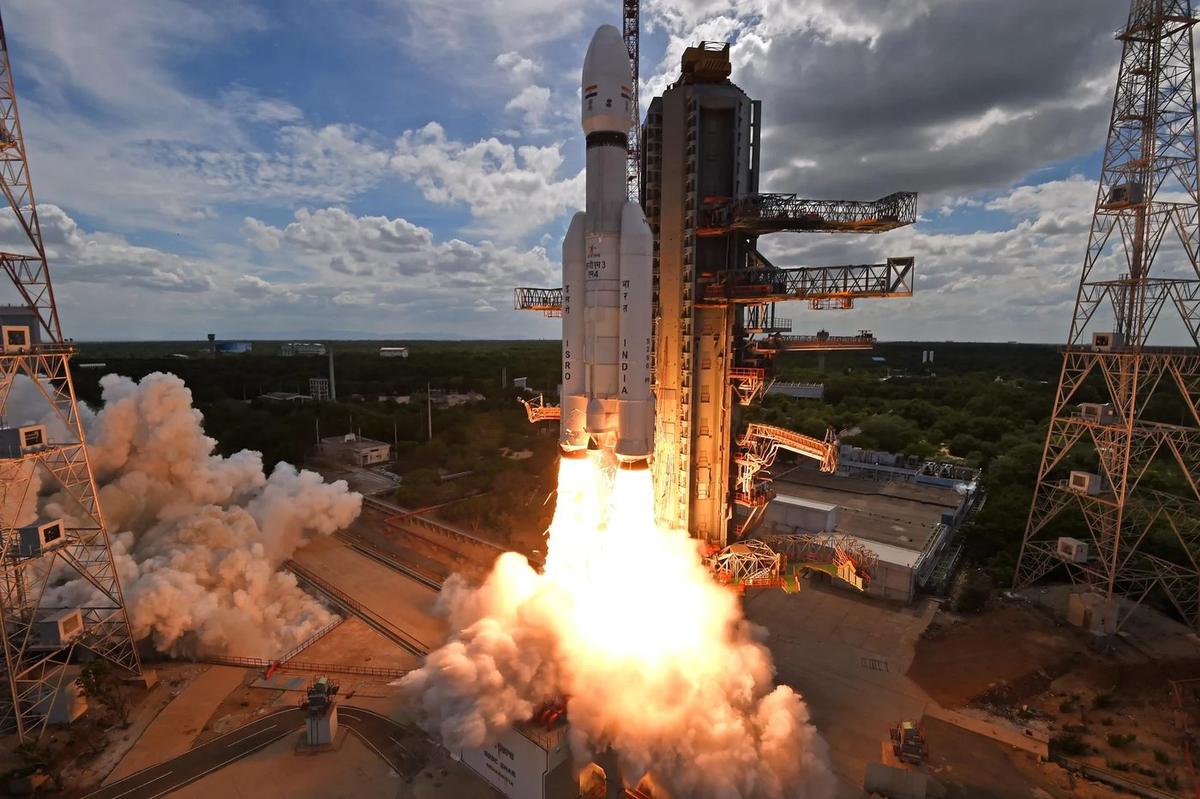
Photo: LVM3 launch, Sriharikota, ISRO, GODL-India

APPSC Group-I Mains 2023 · Paper V
2023 Paper V · Q1(a): model answer
Science, Technology & Environmental Issues · Science and technology policy, institutions and IPR. Held in June 2023 (Notification 28/2022).
Do you think the problem in India is 'not so much knowledge creation, as knowledge consumption' and Scientific Social Responsibility (SSR) will go a long way in remedying this situation? Justify your stand. Discuss the challenges associated with the implementation of Scientific Social Responsibility.
Syllabus: Science and technology policy, institutions and IPR · Science and technology policy and institutions
Knowledge creation vs consumptionScientific Social ResponsibilityLab-to-society gapScientific temper
India creates knowledge at scale: it is third in the world in scientific publications and received over 1.1 lakh patent applications in 2024-25. Yet much of this stays in journals and laboratories, unused by farmers, small industries, schools or policymakers. Scientific Social Responsibility (SSR), the duty of scientists to share knowledge, facilities and skills with society, was formalised by DST's SSR Guidelines, 2022. The statement is largely valid, with one caveat.
1. Stand: largely agree, with a caveat
- Lab-to-market gap: much publicly funded research ends as papers; university patents are rarely licensed, and MSMEs and farmers seldom use technologies that already exist.
- Lab-to-society gap: superstition, quackery, vaccine hesitancy and misinformation persist despite the fundamental duty to develop scientific temper (Article 51A(h)), so knowledge is not "consumed" by society.
- But creation also lags: R&D spending is only 0.84% of GDP (2023-24) against China's 2.58%, and India has just 354 researchers per million people. SSR complements, but cannot replace, more research funding.
| Indicator | Latest figure | What it shows |
|---|---|---|
| Scientific publications | 3rd in the world (2022) | Strong creation |
| Patent applications | 1,10,375 in 2024-25 (62% by residents) | Rising creation |
| R&D spending (GERD) | 0.84% of GDP (2023-24) | Under-investment |
| Researchers | 354 per million people | Thin research base |
| Competitive extramural grants | About 1.4% of GERD | Weak university research |
| Global Innovation Index 2026 | 38th; institutions 60th, business sophistication 63rd | Weak links between research and use |
2. How SSR can remedy the situation
- Knowledge sharing: scientists give public lectures, train teachers, mentor students and explain research in local languages; the guidelines ask for at least 10 days of SSR a year, credited in performance appraisal.
- Sharing facilities: laboratories open costly instruments to colleges, start-ups and MSMEs that cannot afford them.
- Demand-driven research: contact with farmers, fishers and local bodies helps scientists pick real problems; the CSIR Aroma Mission (Vigyan Team award, 2025) took aromatic crops and distillation to farmers.
- Trust and scientific temper: CSIR's Jigyasa (student–scientist connect) and Unnat Bharat Abhiyan (institutions adopting villages) build a culture of inquiry.
3. Challenges in implementing SSR
- Non-binding guidelines: SSR is voluntary, so institutions apply it unevenly.
- Incentives and workload: promotions still reward papers and grants; teaching-heavy state universities have little spare time.
- No dedicated funds: travel, outreach and instrument-sharing costs lack a budget line.
- Measuring impact: counting hours is easy, judging real social benefit is hard, so SSR risks becoming box-ticking.
- Language and access: most science is in English, while rural and tribal users need field-level, local-language communication.
AP angle: APCOST (Vijayawada), IIT and IISER Tirupati, NARL Gadanki and ANGRAU can anchor SSR through school adoption, farmer outreach and shared laboratories, with the Ratan Tata Innovation Hub (2025) linking them to start-ups.
SSR turns science from an ivory-tower activity into a public good. Backed by funds, appraisal credit and impact measures, and by higher R&D spending through ANRF, it can make India both a creator and a user of knowledge.
The other choice in Q1
Answer either one in the exam.
- Q1(b)Technology plays a key role in transforming healthcare sector and in addressing India's healthcare challenges - Discuss.
10 marks · Biotechnology and health · Health and diseases
Every model answer on these pages is free to read. The Tool Kit adds four PDF books for Mains Papers I–IV: every previous question sorted by syllabus, with practice questions. It is in the ₹149 All-in-One Pass, with every previous paper of every exam on the site, practice quizzes, timed tests, mock test series and study books.
₹149 · valid for 12 months from the day you pay, on every exam · pay by UPI, card or net banking