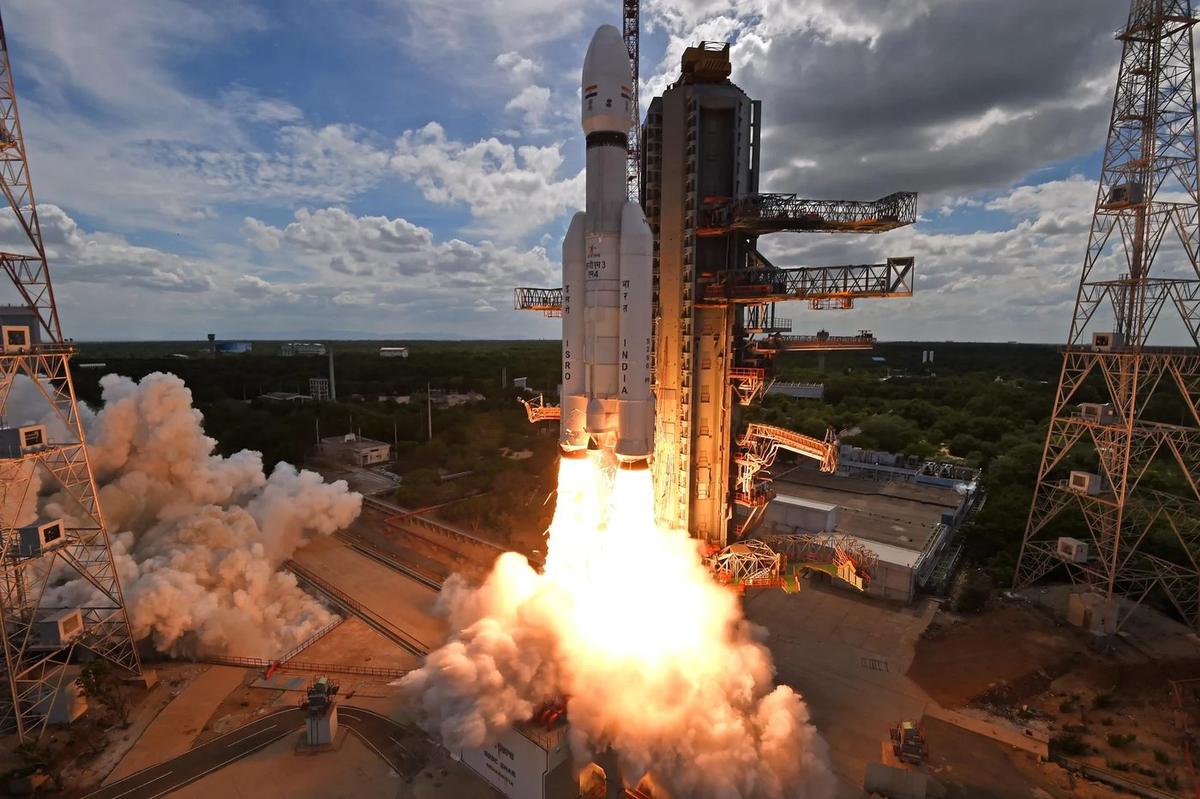
Photo: LVM3 launch, Sriharikota, ISRO, GODL-India

APPSC Group-I Mains 2023 · Paper V
2023 Paper V · Q14(a): model answer
Science, Technology & Environmental Issues · Space, defence and nuclear technology. Held in June 2023 (Notification 28/2022).
What are the reasons behind the India's opposition to sign the Non-Proliferation of nuclear weapons (NPT)? Discuss the impact of the civil nuclear agreement with the Nuclear Supplier Group (NSG) on nuclear power generation in India.
Syllabus: Space, defence and nuclear technology · Nuclear technology and policy
NPTNSG waiver123 AgreementNuclear power
The Treaty on the Non-Proliferation of Nuclear Weapons (NPT, 1968) recognises as nuclear-weapon states only the five that tested before 1 January 1967. India has refused to sign it, yet it has kept a clean non-proliferation record. In 2008, after the Indo-US civil nuclear initiative, the Nuclear Suppliers Group (NSG) granted India a special waiver (6 September), ending more than three decades of nuclear isolation.
1. Reasons for India's opposition to the NPT
- Discriminatory: it divides the world into nuclear "haves" and "have-nots"; India could join only as a non-nuclear-weapon state by giving up its weapons.
- No disarmament deadline: the nuclear-weapon states need only negotiate disarmament "in good faith" (Article VI), with no time-bound duty.
- Security environment: two nuclear-armed neighbours, China (since 1964) and Pakistan, and their nuclear cooperation require a credible deterrent.
- Strategic autonomy: India seeks universal, non-discriminatory and verifiable disarmament, as in the Rajiv Gandhi Action Plan (1988), not an unequal treaty.
- Responsible conduct outside the treaty: a no-first-use doctrine (2003), a testing moratorium since 1998 and strict export controls.
- 1968 NPT signed; India stays out
- 1974 Pokhran-I; NSG formed in response (1975)
- 1998 Pokhran-II and a testing moratorium
- 2008 IAEA safeguards; NSG waiver; 123 Agreement
- 2016–18 Joins MTCR, Wassenaar, Australia Group
- 2025 SHANTI Act replaces the 1962 and 2010 laws
2. Impact of the 2008 deal on nuclear power
| Aspect | Before 2008 | After 2008 |
|---|---|---|
| Fuel | Scarce domestic uranium; reactors underused | Imports from Russia, Kazakhstan, Canada and others |
| Installed capacity | about 4,120 MW (2008) | 8,780 MW from 24 reactors (2026) |
| Foreign partners | Mostly cut off after 1974; Kudankulam (Russia) an exception | Agreements with the USA, France, Russia, Canada, Kazakhstan, Australia, Japan |
| Safeguards | A few reactors | Civilian reactors under IAEA; Additional Protocol (2014) |
- Fuel security: imported uranium for safeguarded reactors ended the shortage that had kept many reactors running well below capacity, and load factors rose.
- Slow growth: capacity roughly doubled in 18 years, mostly from indigenous 700 MWe PHWRs (Kakrapar 3 and 4, RAPP-7) and the Russian VVERs at Kudankulam; nuclear still gives only about 3% of electricity.
- Stalled foreign projects: Jaitapur (France) and Kovvada (USA) stalled over the supplier-liability clause of the 2010 liability law and high costs.
- Diplomatic gains: membership of the MTCR (2016), Wassenaar (2017) and Australia Group (2018), though full NSG membership is still blocked, mainly by China.
- New push: the SHANTI Act 2025 repealed the Atomic Energy Act 1962 and the CLNDA 2010, admitted private Indian companies and graded operator liability; the goal is 100 GW by 2047, helped by a ₹20,000 crore mission for small modular reactors.
AP angle: Kovvada in Srikakulam is planned for 6 × 1,208 MW Westinghouse AP1000 reactors, but NPCIL–Westinghouse talks were still continuing in September 2026; Tummalapalle (YSR Kadapa) uranium supports the domestic fuel cycle.
Staying out of the NPT protected India's strategic autonomy, while the 2008 waiver opened access to fuel and technology; turning that access into power now depends on cost, legal clarity and indigenous capacity.
The other choice in Q14
Answer either one in the exam.
- Q14(b)What are e-waste recycling practices in India? Discuss the highlights of new e-waste management rules 2022 notified by the Government of India.
10 marks · Pollution, waste and climate change · Pollution and waste management
Every model answer on these pages is free to read. The Tool Kit adds four PDF books for Mains Papers I–IV: every previous question sorted by syllabus, with practice questions. It is in the ₹149 All-in-One Pass, with every previous paper of every exam on the site, practice quizzes, timed tests, mock test series and study books.
₹149 · valid for 12 months from the day you pay, on every exam · pay by UPI, card or net banking