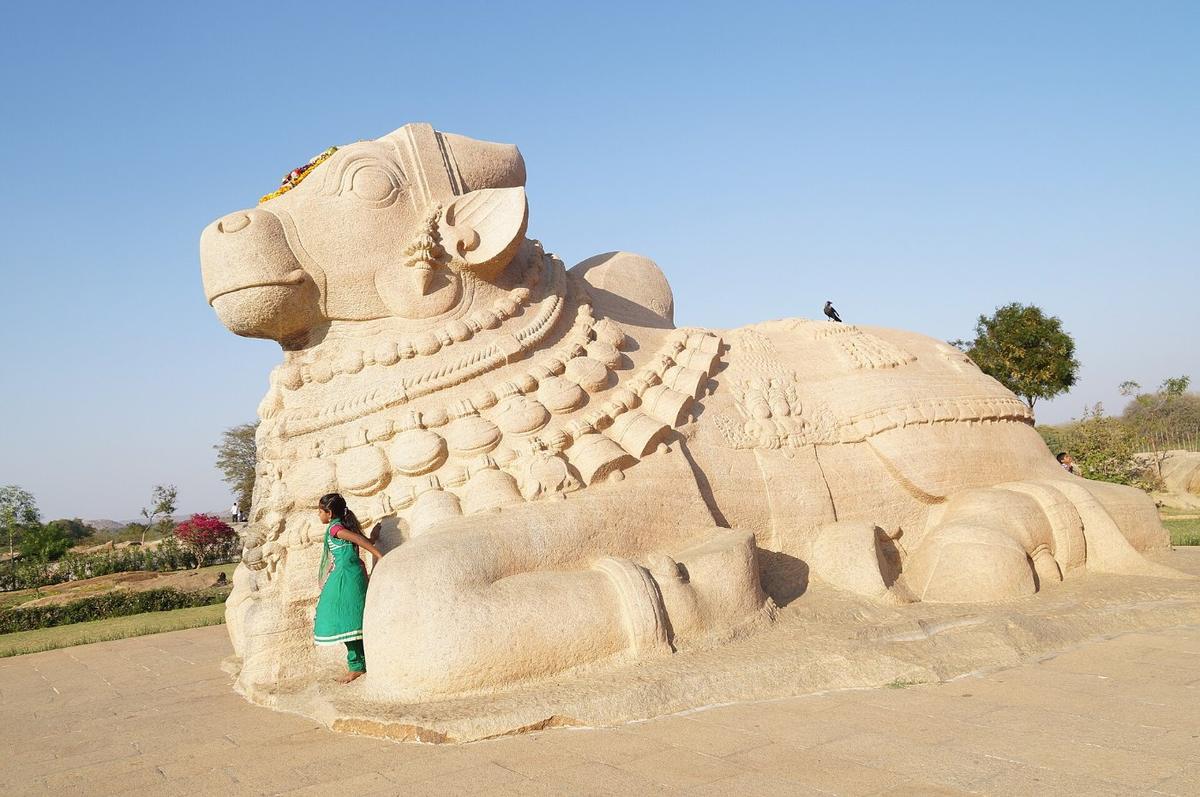
Photo: Lepakshi Nandi, Rahmanuddin, CC BY-SA 4.0

APPSC Group-I Mains 2023 · Paper II
2023 Paper II · Q13(b): model answer
History, Culture & Geography of India and Andhra Pradesh · Farming, Industry and People. Held in June 2023 (Notification 28/2022).
What are different types of rural settlements and factors affecting them ? Add a note on rural settlement patterns in India.
Syllabus: Farming, Industry and People · Tribes, castes, religions, languages and settlements
Rural settlementsClustered and dispersedSettlement patternsSite factors
A rural settlement is a group of dwellings whose people depend mainly on primary activities such as farming, fishing, forestry and herding. NCERT classifies Indian rural settlements into four types, clustered, semi-clustered, hamleted and dispersed, while their shape (pattern) depends on relief, water, transport routes, security and social structure.
| Type | Main features | Typical regions |
|---|---|---|
| Clustered (compact, nucleated) | Compact built-up area with streets, distinct from the fields | Northern plains, Bundelkhand, Nagaland; Rajasthan around scarce water |
| Semi-clustered (fragmented) | A cluster with some groups, often by caste, living apart on the edge | Gujarat plains, parts of Rajasthan |
| Hamleted | Village split into hamlets sharing a common name (panna, para, palli, nagla, dhani) | Middle and lower Ganga plain, Chhattisgarh, lower Himalayan valleys |
| Dispersed (isolated) | Scattered huts or homesteads in forests, hills or remote fields | Meghalaya, Uttarakhand, Himachal Pradesh, Kerala |
1. Types of rural settlements
- Clustered: found on fertile plains where intensive farming, social cohesion and defence favour living together; in dry areas, scarce water also draws people together.
- Semi-clustered: results from the segregation of a large village or from groups moving to its edge, often along caste lines.
- Hamleted: social and ethnic factors split a village into physically separate units (hamlets) that keep a common name.
- Dispersed: rugged terrain, dense forests and small patches of cultivable land force families to live apart.
2. Factors affecting rural settlements
- Physical: relief, altitude, soil fertility, climate, drainage and the availability of water decide where people settle; wet-point sites lie near rivers, tanks and springs, and dry-point sites stand on raised ground above flood level.
- Cultural and ethnic: caste structure, religion and tribal customs shape layout; segregation produces semi-clustered and hamleted forms.
- Security: defence against raiders and wild animals favoured compact, walled or hilltop villages.
- Economic: intensive farming favours clusters, while plantations, ranching and shifting cultivation favour scattered homesteads.
- Transport: roads, railways and canals attract new settlements and shape linear patterns.
- Planning: canal colonies and resettlement colonies have planned, regular layouts.
3. Rural settlement patterns in India
- Linear: along roads, rivers, canals and coasts, as on the Kerala coast and along delta canals.
- Rectangular: on plains and wide valleys, with roads crossing at right angles.
- Circular: around lakes and tanks, or arranged in a ring for defence.
- Star-like: where several roads converge on a village.
- T, Y or cross-shaped: at road junctions.
- Double village: on both banks of a river, linked by a bridge or ferry.
AP angle: compact villages are typical of the deltas and Rayalaseema; linear villages line the canals and the coast; tribal hamlets (gudems) are dispersed in the Eastern Ghats agency, and names ending in -palli and -gudem reflect hamlet origins.
Schemes such as PMAY-Gramin, SVAMITVA (2020) and the Rurban Mission (2016) aim to make rural settlements planned and sustainable.
The other choice in Q13
Answer either one in the exam.
- Q13(a)Give a description of the 'demographic dividend' in the Indian context.
10 marks · Farming, Industry and People · Population, migration and urbanisation
Every model answer on these pages is free to read. The Tool Kit adds four PDF books for Mains Papers I–IV: every previous question sorted by syllabus, with practice questions. It is in the ₹149 All-in-One Pass, with every previous paper of every exam on the site, practice quizzes, timed tests, mock test series and study books.
₹149 · valid for 12 months from the day you pay, on every exam · pay by UPI, card or net banking