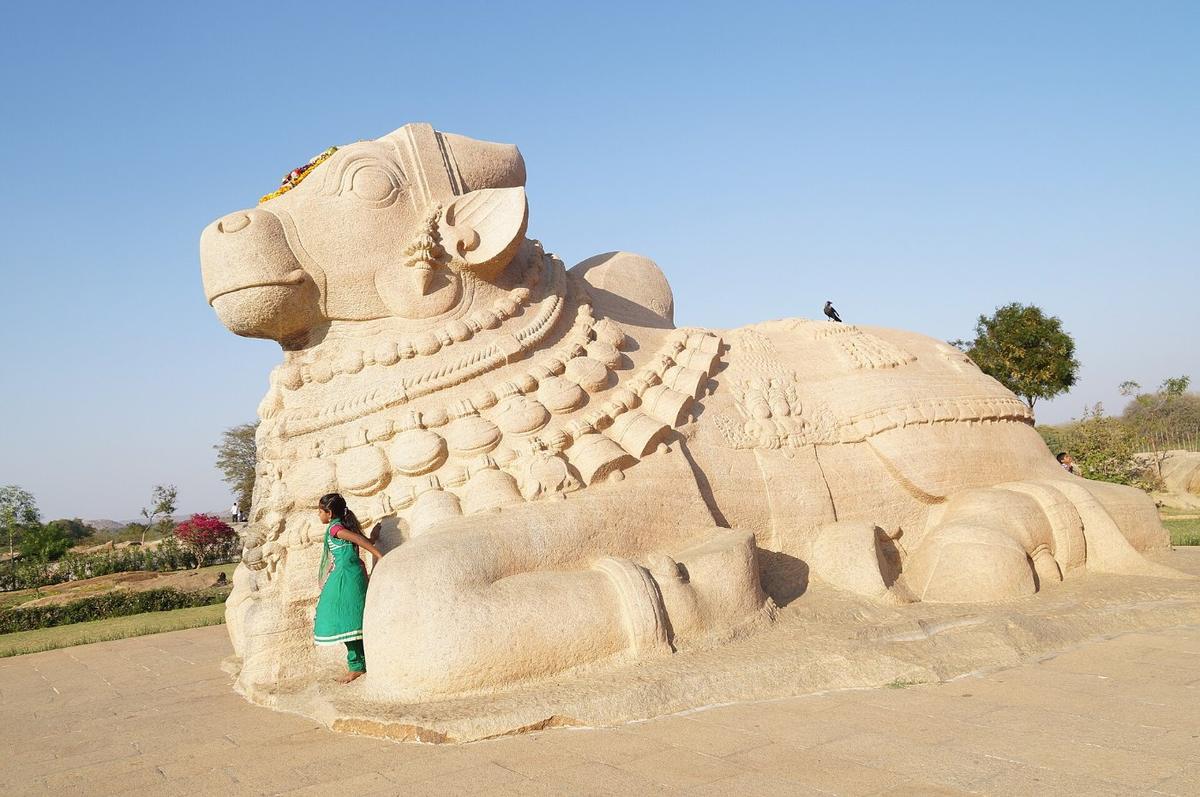
Photo: Lepakshi Nandi, Rahmanuddin, CC BY-SA 4.0

APPSC Group-I Mains 2020 · Paper II
2020 Paper II · Q10(a): model answer
History, Culture & Geography of India and Andhra Pradesh · United Andhra Pradesh and the 2014 Split. Held in December 2020 (Notification 27/2018).
Discuss the revenue and infrastructural challenges for new Andhra Pradesh after bifurcation in 2014.
Syllabus: United Andhra Pradesh and the 2014 Split · Economic effects of the 2014 split
AP Reorganisation Act 2014Revenue deficitCapital cityThirteenth Schedule
The Andhra Pradesh Reorganisation Act, 2014 divided the state on 2 June 2014. Residual Andhra Pradesh got about 58% of the population but lost Hyderabad, the hub of revenue, services and institutions; Hyderabad remained the common capital for ten years (till 2 June 2024). The new state thus began with a revenue deficit, no capital city and a weak base of institutions and infrastructure.
1. Revenue challenges
- Loss of Hyderabad: its high-yield revenues from IT, services and real estate went to Telangana, leaving AP's agriculture-heavy economy with a narrower tax base.
- Liabilities by population: assets and liabilities, including debt and pensions, were divided largely in the population ratio (58.32:41.68), leaving AP with a larger share of liabilities than of revenue.
- Revenue deficit: AP ran a revenue deficit from the first year; the 14th Finance Commission recommended revenue deficit grants of ₹22,113 crore for 2015–20.
- Special status: Special Category Status was not granted; a Special Assistance Measure (2016) was offered instead.
- Disputes: division of Schedule IX and X institutions and power dues with Telangana remained contentious.
2. Infrastructure challenges
- No capital city: Amaravati was planned through land pooling, and the Secretariat, Assembly and High Court (functioning there from 1 January 2019) had to be built from scratch.
- Few premier institutions: major hospitals, universities and research bodies were concentrated in Hyderabad.
- Weak industrial and IT base: most large industries, IT firms and corporate offices were in and around Hyderabad.
3. Promises of the Act
- Institutions (Thirteenth Schedule): an IIT, NIT, IIM, IISER, AIIMS and central and tribal universities were promised and have since been set up (see map).
- Pending projects: Polavaram (a national project under Section 90), a steel plant at Kadapa, a major port, a petrochemical complex, metro rail and a railway zone at Visakhapatnam.
- Backward regions: special development support was promised for Rayalaseema and North Coastal Andhra.
Shaded: the seven backward districts of Rayalaseema and North Coastal Andhra given special grants under the Act (Budget 2024-25 also named Prakasam)
Schematic map of Andhra Pradesh (2011 census district outlines), not to scale; for study only.
4. Latest
- Union support: the Union Budget 2024-25 announced ₹15,000 crore of support through multilateral agencies for Amaravati, a commitment to complete Polavaram, and grants for the backward regions of Rayalaseema, Prakasam and North Coastal Andhra.
- New investment: large investments, such as the Google AI hub at Visakhapatnam, signal a shift towards coast-led growth.
Fiscal prudence, timely fulfilment of the Act's promises and coast-led growth are the way forward for a state that had to rebuild its capital, finances and institutions at the same time.
The other choice in Q10
Answer either one in the exam.
- Q10(b)Discuss the impact of bifurcation of Andhra Pradesh (2014) on trade and commerce.
10 marks · United Andhra Pradesh and the 2014 Split · Economic effects of the 2014 split
Every model answer on these pages is free to read. The Tool Kit adds four PDF books for Mains Papers I–IV: every previous question sorted by syllabus, with practice questions. It is in the ₹149 All-in-One Pass, with every previous paper of every exam on the site, practice quizzes, timed tests, mock test series and study books.
₹149 · valid for 12 months from the day you pay, on every exam · pay by UPI, card or net banking